

Contact us
Connect with our expert today.
Learn how Indian nurses can get a nursing job in Germany in 2026. Explore salary, eligibility, B2 German requirements, visa process, Approbation, PR pathway, and step-by-step guidance.

Germany’s healthcare system is running out of nurses.
And Indian nurses are becoming some of the most sought-after professionals to fill that gap.
That sentence, simple as it sounds, explains why over 16,600 Indian nurses are already working in German hospitals and care homes as of 2025 — and why that number is growing faster than any other source country. Germany is not just open to Indian nurses. It is actively and urgently seeking them.
Germany is currently facing a shortage of approximately 30,000 to 40,000 nurses across hospitals and elderly care facilities. The shortage is largely driven by the country's ageing population, which continues to increase demand for long-term and acute healthcare services. Germany requires 150,000 additional nurses by 2028 according to the Federal Employment Agency, with the nursing shortage projected to reach 500,000 by 2030 due to its ageing population.
For decades, Germany filled these gaps with nurses from Eastern European countries like Poland, Romania, and Bosnia. But as living standards in those countries have risen, migration flows have slowed significantly. Germany is now looking to India, Indonesia, and the Philippines and Indian nurses are consistently rated as among the most qualified and committed international candidates.
The opportunity is real. The process is structured. And for Indian nurses who prepare correctly, the path to a career in Germany with competitive salaries, employer support, and a clear route to permanent residency is more accessible in 2026 than it has ever been.
This guide breaks down everything Indian nurses need to know about working in Germany in 2026 from eligibility and salary to licensing, language requirements, and the complete step-by-step process
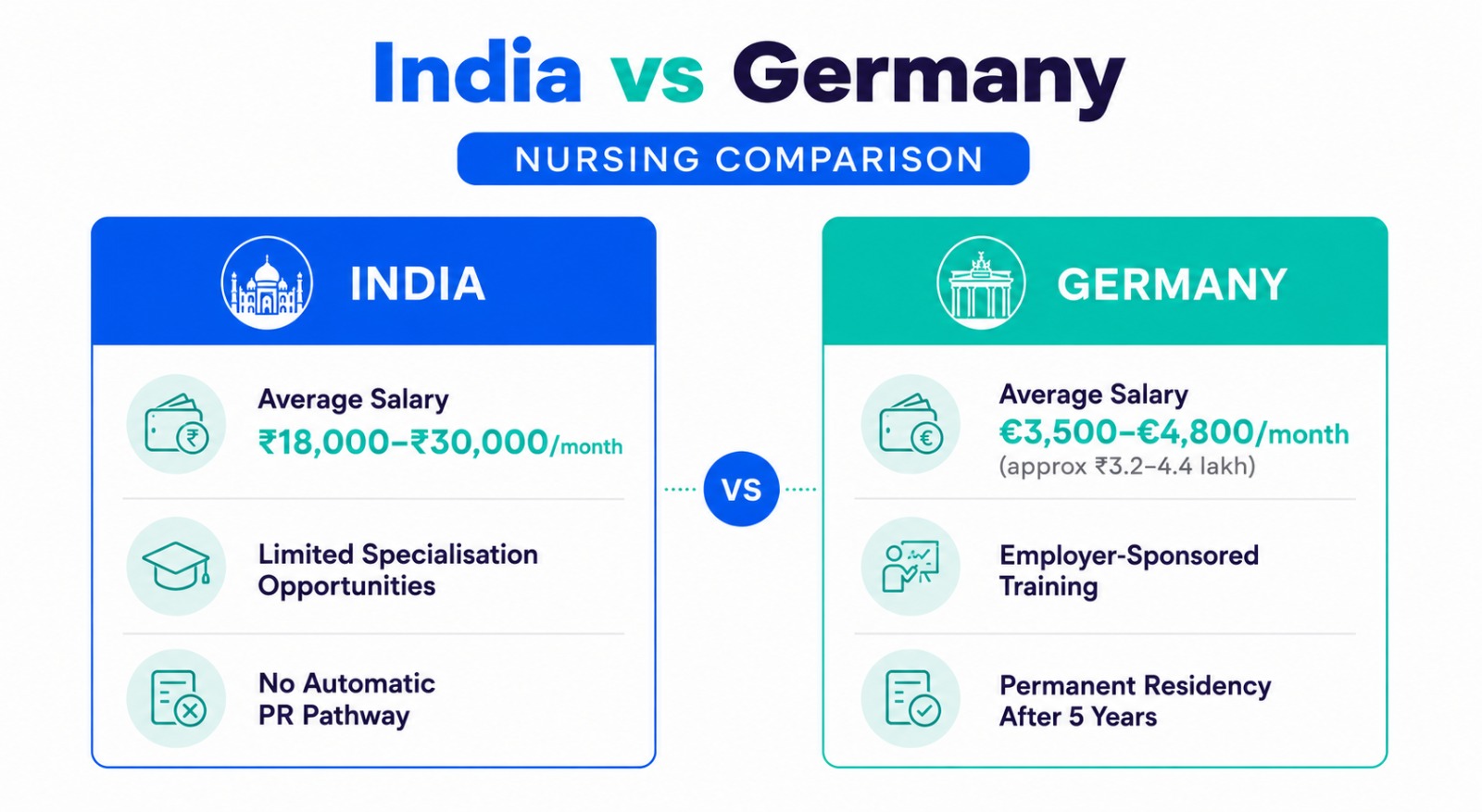
Germany offers average salaries of €3,500–€4,800 per month for registered nurses, provides employer-sponsored recruitment and language training, and offers a clear pathway to permanent residency. Indian nurses are among the most preferred international candidates due to their qualifications and clinical training standards.
Foreign workers currently make up 16% of Germany's 1.69 million nurses and caregivers, with active recruitment from India, the Philippines, Brazil, and Vietnam.
For Indian nurses, the timing is significant for three specific reasons:
The demand is long-term, not temporary. Germany's shift, an ageing population and a declining birth rate, means nursing demand is not a short-term spike. It is a long-term, government-recognised crisis that is driving policy, funding, and active international recruitment.
The recognition process has been streamlined. A Recognition Partnership Launch in March 2024 introduced a new policy that allows nursing assistants to begin working immediately upon arrival while qualifications undergo verification eliminating previous waiting periods.
The financial case is compelling. The average nurse salary in India is ₹18,000–₹30,000 per month. Even in the recognition phase, German salaries are 10 times higher.
Yes. Indian nurses with a 3-Year GNM diploma or 4-Year BSc Nursing degree from an INC-recognised institution, a B2 level German language certificate, a valid State Nursing Council registration, and a job offer from a German employer are eligible to work in Germany. Clinical experience of at least 6 months is preferred, though freshers are considered.
Here is what you need: a GNM (General Nursing and Midwifery) diploma OR BSc Nursing degree from an INC-recognised institution, German language B2 level certification (TELC or Goethe accepted), a valid Nursing Registration Certificate from your State Nursing Council, and minimum clinical experience — most hospitals prefer at least 6 months, but freshers can also get jobs. There is no official upper age limit, though most candidates are between 22 and 40.
Eligibility requirements for Indian nurses applying to Germany
Registered nurses in Germany earn between €3,500 and €4,800 per month on average. During the recognition (adaptation) phase, salaries start at approximately €2,800–€3,200 per month as a nursing assistant. With experience and specialisation, salaries can reach €5,000+ per month. All salaries include Germany's comprehensive social security benefits.
The average salary of a registered nurse in Germany ranges between €2,500 and €4,800 per month, with the average annual salary of approximately €37,000–€57,000 depending on experience, location, specialisation, and employer type. Nurse salaries increased 4.7% in 2024, with further growth expected in 2026.
Nursing assistant minimum hourly wage rose from €15.50 to €16.10 in July 2025, translating to €2,685–€2,793 monthly base salary. The next legislated increase occurs on July 1, 2026, raising the rate to €16.52 per hour. Qualified nursing assistants with at least one year of certified training receive a higher minimum of €17.35, rising to €17.80 in July 2026.
Southern German states such as Bavaria and Baden-Württemberg offer 12–18% higher salaries than eastern regions. Public hospitals and those under church-run collective agreements like Caritas or Diakonie often pay 10–15% above statutory minimum rates.
Salary breakdown for Indian nurses in Germany 2026
QUICK COMPARISON: India vs Germany nursing salary
Beyond base salary, German employers typically provide:
B2 level German proficiency is required by most German employers for clinical nursing practice. B1 is the minimum to begin the application process. Accepted certificates are Goethe B2, TELC B2, and ÖSD B2. Learning from A1 to B2 typically takes 12–14 months with consistent daily study. Some employers offer free or subsidised language training.
The German language requirement is not a bureaucratic hurdle. It is a patient safety standard, and it is the single most important step you must take before everything else.
The minimum level required is B1 German (CEFR) to initiate the application. Direct patient care positions and most employers require B2 level certification. Tests accepted include Goethe-Institut, telc, or TestDaF language certificates. German proficiency not only increases professional integration but also improves everyday life.
Learning from A1 to B2 is a process that takes approximately 12–14 months with consistent daily training.
German language levels and what they mean for nurses
Important: Do not attempt to shortcut the language requirement. B2 is non-negotiable for most German employers and is verified at every stage — during recognition, during the visa application, and in the workplace. Begin language training as your very first step — before documents, before applications, before anything else.
Berufsanerkennung is the process by which German authorities assess whether your Indian nursing qualification is equivalent to German standards. Applications are submitted to the competent authority (Landesprüfungsamt) in your target German state. The outcome is full recognition, partial recognition (requiring an adaptation period), or non-recognition. Most Indian GNM and BSc Nursing graduates receive partial recognition and complete an adaptation period of 3–6 months while employed.
Your Indian nursing qualification whether GNM or BSc will not automatically be accepted in Germany. It must go through a structured recognition process called Berufsanerkennung before you can practice as a fully registered nurse (Approbation holder).
Here is how it works:
Step 1 — Submit to the Landesprüfungsamt Your documents like nursing degree certificates, mark sheets, syllabus, clinical hours proof, State Nursing Council registration etc are submitted to the competent authority in your target German state. Each state has its own authority and its own processing timeline.
Step 2 — Assessment Decision The authority issues one of three decisions:
Step 3 — Adaptation Period (if required) The adaptation measure refers to practical or theoretical training leading to full recognition of the equivalence of a professional qualification. This includes measures such as placements, second-chance training, and so on. This adaptation period typically lasts 3–6 months and is completed while employed in Germany meaning you are earning a salary throughout.
Step 4 — Approbation Once the adaptation period is completed and assessed, the full nursing licence (Approbation) is granted by the state health authority. You are now a fully registered nurse in Germany.
Berufsanerkennung process timeline
There are two primary visa types for Indian nurses going to Germany: the §16d Recognition Visa (for nurses whose recognition is still in progress) and the §18a Skilled Worker Visa (for nurses with full Berufsanerkennung already completed). Most Indian nurses travel on the §16d visa, arrive in Germany, begin working at their employer, and complete their recognition adaptation period while already employed.
There are two visa types relevant for Indian nurses going to Germany, and which one applies depends on where you are in the recognition process. Most nurses travel on the §16d Recognition Visa — which means they go to Germany, begin working at their hospital or care home, and complete their recognition adaptation period while already employed and earning.
The work visa for qualified professionals under §18a of the Residence Act can only be issued if the applicant fulfils the professional requirements — full recognition and licence to practise the profession — and can provide evidence of a concrete offer of employment as a nurse in Germany. Note: The EU Blue Card does not apply to nursing professionals.
Documents required for German nursing visa application
A valid employment contract from a recognised German hospital or care home, either a full Berufsanerkennung decision or a preliminary recognition notice confirming the application is in process, a valid TELC B2 or Goethe B2 German language certificate, valid State Nursing Council registration apostilled, a valid Indian passport with at least 12 months validity beyond the intended travel date, proof of accommodation in Germany, health insurance confirmation for the initial period, a completed visa application form from india.diplo.de, and 2 recent biometric passport photographs.
The German Embassy in India has two main locations — New Delhi and Mumbai. There are also Consulates in Chennai, Kolkata, and Bengaluru. Apply at the Embassy or Consulate closest to your place of residence.
How do I get a nursing job in Germany from India step by step?
The process has 7 stages: start German language training (A1 to B2, 12–14 months), prepare and apostille your documents, apply for Berufsanerkennung through the state authority, receive a job offer from a German employer, apply for a German nursing visa, arrive and complete adaptation period if required, and receive full Approbation. Total timeline: 18–24 months from starting language training to working as a registered nurse.
Step 1 — Begin German Language Training (A1 to B2) Timeline: 12–14 months This is the foundation of everything. Begin immediately. Goethe Institut, TELC, and certified language schools across India offer structured programmes. Some employers sponsor or reimburse language training costs.
Step 2 — Prepare and Apostille Your Documents Timeline: 4–8 weeks Gather all nursing certificates, mark sheets, clinical training records, State Nursing Council registration, and ID documents. All documents must be apostilled and translated into German by a certified translator. A poorly prepared document set is the most common cause of delays.
Step 3 — Apply for Berufsanerkennung Timeline: 3–6 months for assessment Submit your apostilled documents to the Landesprüfungsamt in your target German state. Each state has a different authority and processing time. Your recognition outcome will determine which visa pathway applies.
Step 4 — Secure a Job Offer Timeline: Concurrent with recognition process Apply to German hospitals and care homes. Major employers actively recruiting Indian nurses include Charité – Universitätsmedizin Berlin, Helios Kliniken Group, Asklepios Kliniken, Vivantes Hospital Group, and university hospitals in Munich, Hamburg, and Heidelberg. A job offer is required before your visa application.
Step 5 — Apply for Your German Nursing Visa Timeline: 6–12 weeks processing Apply at the German Embassy or Consulate in your state. Visa is issued once all documents — recognition notice, job offer, language certificate, and supporting documents — are verified.
Step 6 — Arrive in Germany Timeline: Within visa validity After arriving in Germany: open a German bank account — your employer needs this for salary payments. Deutsche Bank, Commerzbank, and N26 (digital) are popular choices for new arrivals. Register with a statutory health insurance provider (Krankenversicherung) — your employer will guide you. Obtain your German tax identification number (Steueridentifikationsnummer) — sent automatically after registration, usually within 2–3 weeks.
Step 7 — Complete Adaptation and Receive Approbation Timeline: 3–6 months after arrival Complete your adaptation period (if required) while employed and earning your nursing assistant salary. On successful completion, Approbation is granted — you are now a fully registered nurse in Germany.
Complete timeline from start to registered nurse in Germany
Can Indian nurses get permanent residency in Germany?
Yes. After 5 years of legal employment in Germany with sufficient income, a basic level of German (B1), and completion of integration requirements, Indian nurses are eligible for a permanent settlement permit (Niederlassungserlaubnis). German citizenship is available after 5 years, with a reduction possible for exceptional cases.
For most Indian nurses, Germany is not just a career move. It is a life decision. And the pathway to permanence is clear and structured.
After receiving Approbation and working as a registered nurse:
Most guides about nursing in Germany stop at the process. Here is what actually determines whether the journey goes smoothly:
The state you target matters enormously. Each German state has a different Landesprüfungsamt, different processing times, different labour market conditions, and different salary levels. Bavaria and Baden-Württemberg offer higher salaries. Some states process Berufsanerkennung in 3 months; others take 6. Choosing the right state for your profile is a strategic decision, not a logistical one.
B2 German is not optional — it is the prerequisite for everything. The nurses who struggle in Germany are almost always the ones who underinvested in language training. Commit to B2 from day one.
The employer you choose determines the quality of your experience. Church-run hospitals (Caritas, Diakonie) and large university hospitals typically pay 10–15% above the statutory minimum and offer stronger integration support. Not all employers are equal — choose carefully.
Document quality determines recognition speed. Incomplete, poorly apostilled, or inconsistently translated documents are the single biggest cause of delays. Invest in this step properly.
The adaptation period is an opportunity, not an obstacle. You arrive, you work, you earn, and you complete recognition. The nurses who approach this phase strategically — building German relationships, demonstrating clinical competence, and learning quickly — receive their Approbation faster and enter employment on better terms.
For 45 years, we have guided people through some of the most important decisions of their lives. Our nursing pathway for Germany is built on the same principle that has always driven us: no misinformation, no shortcuts, and no disappearing after the process begins.
At Winny Global, we guide Indian nurses through every stage of the Germany nursing journey:
Language Strategy — We assess your current level and help you map the fastest, most structured route to B2 certification with recognised training partners.
Document Preparation — We guide the complete apostille and certified translation process, ensuring your document set meets the specific requirements of your target German state.
Berufsanerkennung Guidance — We identify the right Landesprüfungsamt for your profile, prepare your submission, and manage the process through to your recognition outcome.
Employer Matching — We connect you with verified German healthcare employers actively recruiting Indian nurses, with transparent employment contract review.
Visa Support — We prepare your complete visa application, ensure every document is correct, and guide you through the German Embassy process in India.
Post-Arrival Support — We do not disappear after you land. We stay present through your adaptation period, Anmeldung (address registration), health insurance enrolment, and the steps toward Approbation.
Long-Term Planning — From the day you arrive, we help you understand the residency milestones ahead and the decisions that protect your path to permanence.
Your dream of building a nursing career in Germany is real. We will make sure the path is too.
