

Contact us
Connect with our expert today.
Learn what Ausbildung in Germany is, salary, eligibility, visa process, German language requirements, and PR pathway for Indian students in 2026

Most Indians planning to move to Germany think of two pathways: a university degree or a work visa. Very few know about a third option,one that charges no tuition fees, pays you a monthly salary from day one, combines classroom learning with real workplace experience, and leads directly to a government-recognised German qualification, long-term employment, and permanent residency.
That option is called Ausbildung.
And in 2026, it is one of the most accessible, financially practical, and strategically intelligent pathways available to Indian students and young professionals planning to build a career in Germany.
According to the Federal Institute for Vocational Education and Training (BIBB), there are over 320 officially recognised training occupations in Germany as of 2026, spanning mechatronics, nursing, banking, IT, baking, and everything in between. The average training salary across all sectors reached approximately €1,070 per month in 2025, with IT and industrial trades paying noticeably more than hospitality or agriculture.
This is Germany's best-kept secret for Indian aspirants and this guide explains everything about it, accurately and completely.
Ausbildung (pronounced "ows-bil-doong") is Germany's dual vocational training system — a government-structured programme where trainees split their time between a company and a vocational school (Berufsschule) simultaneously. A dual education system where you work at a company and attend a vocational school simultaneously. Unlike university, there are no tuition fees. Unlike an internship, you are employed from day one with an actual employment contract and a monthly training salary. The programme typically lasts 2 to 3.5 years depending on the profession and leads to a government-recognised German qualification.
What makes it genuinely different from every other pathway:
You are employed from day one. The moment you begin Ausbildung, you sign an Ausbildungsvertrag, a training contract with a German employer. You are legally an employee with full labour protections, social security contributions, and a monthly training salary called Ausbildungsvergütung.
There are no tuition fees. Most Ausbildung programmes charge no tuition fees and pay a monthly salary. The employer pays for your training. The vocational school is state-funded. You only need to arrange accommodation and living expenses.
The qualification is government-recognized. A completed Ausbildung is a nationally and internationally recognised professional credential. It is not a certificate course or a private qualification — it is a regulated, standardised German professional title that employers across Europe respect.
It is a direct pathway to long-term residency. Graduates can apply for an 18-month job-seeker visa. Working after Ausbildung counts toward permanent residency.
Germany is not just open to Indian Ausbildung applicants. It is actively seeking them.
Germany's skilled worker shortage particularly in healthcare, IT, engineering, and logistics, is one of the most significant economic challenges the country faces. The country requires 150,000 additional nurses by 2027 and faces a total projected shortage of 500,000 skilled workers by 2030. Ausbildung is one of the primary policy mechanisms through which Germany is addressing this gap and Indian applicants are among the most preferred international candidates.
Ausbildung in Germany for Indian students is one of the most affordable, practical, and career-driven pathways available today. The reasons are specific and compelling:
Zero tuition fees against high cost of Indian overseas education. The average cost of a foreign degree for an Indian student including tuition, accommodation, and living costs ranges from ₹30 lakh to ₹1 crore over three to four years. Ausbildung costs nothing in tuition, pays a monthly salary, and takes 2–3.5 years.
Immediate income. Monthly salary starts from €800–€1,200, increasing each year. Even at the lower end, this is 3–5 times the average Indian fresh graduate starting salary.
High job placement rates. Ausbildung trainees earn between €900–€1,300 per month during training, with the amount increasing each year. After completion, average starting salaries range from €2,500–€4,000+ monthly, depending on the field and location.
Legal pathway to stay. Ausbildung is not a student visa arrangement with restricted work rights. It is an employment-based training pathway with full legal status in Germany and a clear progression to permanent residency.
Yes. Indian students are eligible for Ausbildung in Germany with a minimum 10th or 12th standard pass (depending on the profession), B1 German language certificate (B2 recommended and required for healthcare), a signed training contract from a German employer, and a valid Ausbildung visa. There is no official upper age limit, though most candidates are 18–35.
Minimum 10th or 12th standard pass is required depending on the profession. Some technical programmes may require specific subject backgrounds.
Eligibility requirements for Indians applying for Ausbildung in Germany
Training allowances (Ausbildungsvergütung) during Ausbildung range from €800 to €1,300+ per month depending on sector and year of training, increasing each year. Healthcare and IT are the highest paying, starting at €1,040–€1,300. After completing Ausbildung, starting salaries range from €2,500 to €4,000+ per month as a qualified professional.
Ausbildung trainees earn €850–€1,300 per month depending on the sector and year of training. Healthcare and IT sectors pay the highest (€1,040–€1,300), while hospitality starts around €850. Salary increases each year of training, typically by €100–€150 per year.
The minimum training wage (Mindestausbildungsvergütung) legislation introduced in Germany ensures all Ausbildung trainees receive a legal minimum regardless of sector. This minimum increases annually.
Ausbildung salary by sector in Germany 2026 (Exchange rate: 1 EUR ≈ ₹90)

The most in-demand Ausbildung fields for Indian students in 2026 are healthcare and nursing, IT and software development, mechatronics and automotive engineering, hotel management and hospitality, banking and finance, and logistics and warehouse management. Healthcare and IT offer the highest salaries and best job security.
Top Ausbildung courses for Indians in Germany 2026
Germany has a severe shortage of nurses, making nursing one of the most in-demand Ausbildung programmes. Indian students with science backgrounds are highly sought after.
B1 German (CEFR) is the minimum required for most Ausbildung programmes and for the Ausbildung visa application. B2 is strongly recommended and mandatory for healthcare and nursing. Learning from A1 to B1 typically takes 8–10 months; A1 to B2 takes 12–14 months with consistent study.
Germany's official guidance states that German language skills are indispensable for vocational training because companies, vocational schools, and exams are generally conducted in German. As a rule, applicants should be able to provide evidence of at least B1 level German, and higher German levels make the course easier to understand.
German language levels and Ausbildung requirements
Timeline to reach B1 from zero: 8–10 months with consistent daily study (1.5–2 hours per day). Timeline to reach B2 from zero: 12–14 months with consistent daily study.
Accepted language certificates: Goethe-Institut, TELC, TestDaF, or ÖSD. All are accepted for Ausbildung visa applications.
Indian nationals require a Berufsausbildungsvisum (Ausbildung visa) to enter Germany for vocational training. The visa is applied for at the German Embassy in New Delhi or the German Consulate in Mumbai, Chennai, Kolkata, or Bengaluru. It is issued after you have a signed training contract and a B1 German language certificate. The visa is typically issued for the full duration of the training programme.
The applicable visa is the Berufsausbildungsvisum issued by the German Embassy in New Delhi or the German Consulate General in Mumbai, Chennai, or Kolkata, depending on the applicant's region. The visa is applied for after the candidate has a signed Ausbildungsvertrag (training contract) from a German employer and a recognised B1 or B2 German language certificate. The Ausbildung visa is typically issued for the full duration of the training programme — two to three years.
During this period, the visa holder can live and work in Germany as an Ausbildung trainee and travel within the Schengen Area.
If your Ausbildung salary is sufficient (around €934 or more per month), you may not need a blocked account. If salary is lower, you may need to show additional financial proof. This is a significant advantage over the student visa route, which requires a full blocked account of €11,904 per year.
Visa processing time: 6–12 weeks after appointment. Embassy appointment waiting times can be long — apply at least 3–4 months before your intended training start date.
How do I apply for Ausbildung in Germany from India step by step?
The process has 6 stages: start German language training (A1 to B1/B2, 8–14 months), prepare documents, find an employer and secure a training contract, apply for your Ausbildung visa, arrive in Germany and register, and begin your training. Total timeline from starting language training to beginning Ausbildung: approximately 14–20 months.
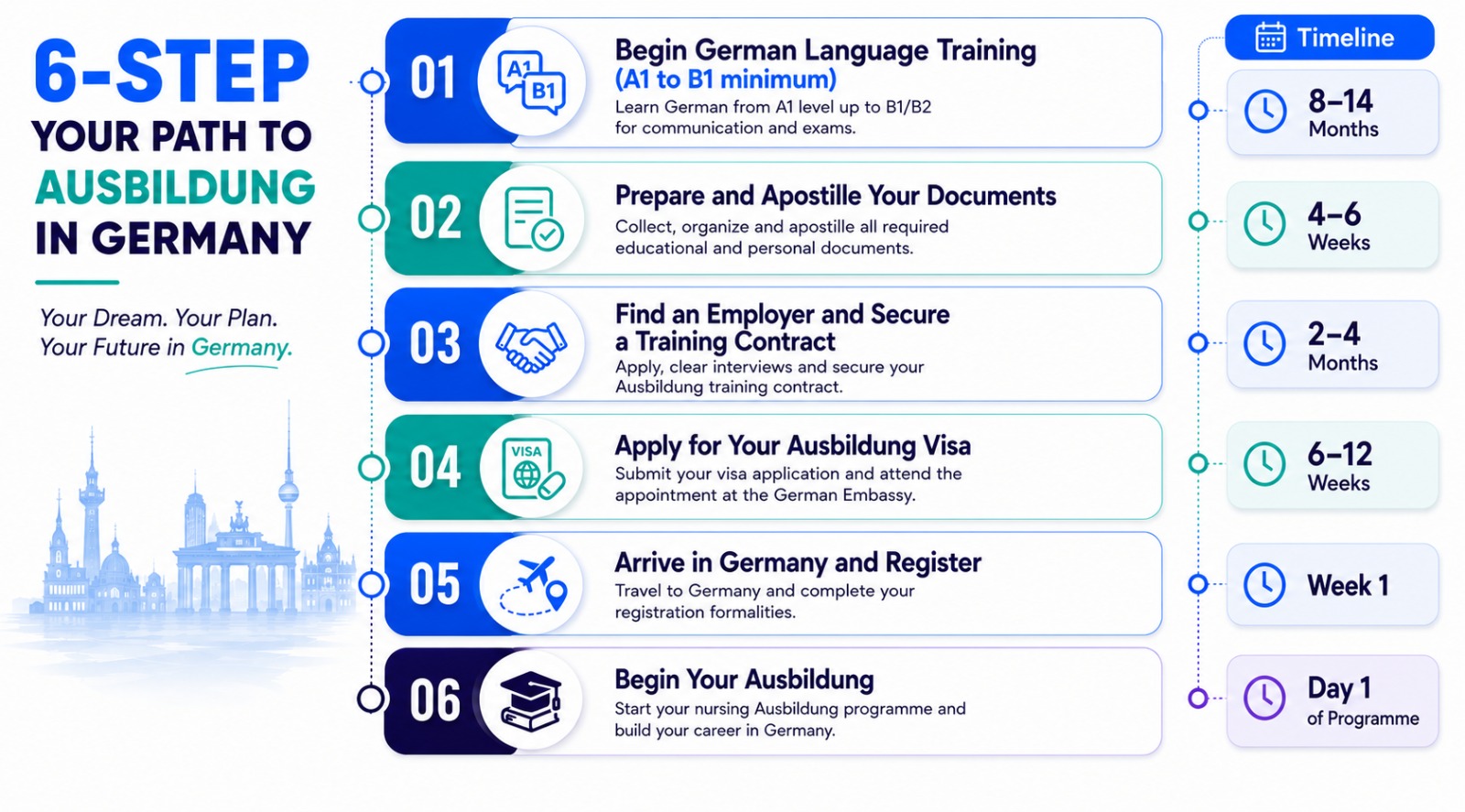
Step 1 — Begin German Language Training (A1 to B1 minimum) Timeline: 8–14 months
This is the foundation. Everything else depends on it. Begin at A1 immediately and work systematically to B1 (minimum) or B2 (recommended). Goethe-Institut, TELC-certified language schools, and online platforms all offer structured courses. Healthcare and nursing candidates must target B2. For all other fields, B1 opens the door — but B2 significantly expands your employer options and increases your salary prospects.
Step 2 — Prepare and Apostille Your Documents Timeline: 4–6 weeks
Gather all educational certificates, mark sheets, and identity documents. All documents submitted to German authorities must be apostilled under the Hague Convention and translated into German by a certified translator. A poorly prepared document set is the most common cause of delays and rejections.
Step 3 — Find an Employer and Secure a Training Contract Timeline: 2–4 months — begin concurrent with language training
You cannot apply for an Ausbildung visa without a signed training contract. Begin your employer search well before you complete your language training. Key job portals for Ausbildung positions include the Bundesagentur für Arbeit (Federal Employment Agency) job portal, JOBBÖRSE, Make it in Germany (the official German government immigration portal), and sector-specific portals for nursing and IT. Begin applications 12–18 months before your desired start date.
Step 4 — Apply for Your Ausbildung Visa Timeline: 6–12 weeks processing after appointment
Apply at the German Embassy in New Delhi or the Consulate in your region. Submit your complete document set — training contract, language certificate, educational certificates, medical fitness certificate, police clearance, and supporting documents. Visa is issued for the full duration of the training programme.
Step 5 — Arrive in Germany and Register Timeline: Within visa validity
Within 14 days of arriving in Germany, complete Anmeldung — the mandatory address registration at your local city office (Einwohnermeldeamt). This is legally required and unlocks access to banking, health insurance enrolment, and other essential services. Open a German bank account — Deutsche Bank, Commerzbank, N26, and DKB are popular options for new arrivals. Enrol with a statutory health insurer (Krankenkasse) — your employer will guide this process.
Step 6 — Begin Your Ausbildung Timeline: Day 1 of training programme
Your dual training begins — split between your employer's workplace and the Berufsschule (vocational school). You receive your first monthly training allowance within the first month. Your salary increases each year of training.
Complete timeline from starting language training to Ausbildung
Yes. After completing Ausbildung and working in Germany for a sufficient period, you are eligible for a permanent settlement permit (Niederlassungserlaubnis) after 5 years of legal employment with adequate income and B1 German. Immediately after completing Ausbildung, you can apply for an 18-month job-seeker visa if your training employer does not offer permanent employment — though most do.
The pathway after Ausbildung is one of the most structured and secure in Germany's immigration system.
Immediately after completion: Graduates can continue working with their training company (most receive job offers), find employment elsewhere in Germany, or apply for an 18-month job-seeker visa. Studies suggest over 70% of Ausbildung trainees receive permanent job offers from their training employer.
Salary jump on qualification: After completing Ausbildung, a newly qualified worker earns between €2,500 and €3,500 per month on average, depending on the occupation and experience. A qualified nurse can earn around €3,000–€3,500.
Post-Ausbildung career and residency pathway
For 45 years, we have guided people through some of the most important decisions of their lives. Our Ausbildung guidance for Germany is built on the same principle that has always driven us honesty, complete information, and support that stays present for the entire journey.
At Winny Global, we guide Indian students and professionals through every stage:
Language Strategy: We assess your current level and map the fastest route to B1 or B2 certification with recognised training partners.
Sector and Employer Guidance: We help you identify the right Ausbildung field for your profile, qualifications, and long-term goals — and connect you with verified German employers actively recruiting Indian candidates.
Document Preparation: We guide the complete apostille and certified translation process, ensuring your document set meets the specific requirements of your target employer and German state.
Visa Support: We prepare your complete Ausbildung visa application, review every document for accuracy, and guide you through the German Embassy process in India.
Post-Arrival Support: We do not disappear after you land. We stay present through Anmeldung, health insurance enrolment, bank account setup, and the first weeks of your training — until you are genuinely settled.
Long-Term Planning: From day one, we help you understand the milestones ahead — the residency pathway, the qualification progression, and the decisions that protect your long-term future in Germany.
Zero tuition fees. A monthly salary from day one. A government-recognised qualification. A clear path to permanent residency.
That is what Ausbildung offers. And that is what Winny Global is here to help you access — correctly, completely, and with full clarity from the very beginning.
